Cashmere can offer substantial warmth with little weight, while a thicker wool piece may feel warmer in everyday use. The comparison depends on more than the fiber: fabric thickness, loft, construction, and coverage all help determine how warm a finished piece feels.
A light scarf tucked inside a coat and a blanket spread across your lap meet different needs. Choosing between wool and cashmere starts with where you want warmth, how much coverage you need, and how much bulk feels comfortable.
This guide explains how fabrics hold warmth, when wool or cashmere may suit your needs, and what a wool-and-cashmere blend can offer. Murmurs pieces provide practical examples, with fabric weights and dimensions to help you compare.
Key Takeaways
- Cashmere can provide warmth in a light, soft layer, but fiber fineness alone does not establish which fabric is warmer at the same weight.
- Fabric weight and size help explain how a piece will feel and fit into your day. They do not, on their own, establish a warmth ranking.
- Under U.S. labeling rules, cashmere fiber must average no more than 19 microns; Merino wool runs from under 17.5 to around 22–24 microns.
- Wool and cashmere are both keratin fibers. Woolmark reports that wool can absorb up to 35% of its weight in moisture before feeling wet; this is not a direct comparison with cashmere.
- Claims that cashmere is "three times" or "eight times" warmer than wool are not a reliable guide without details of the fabrics and test conditions.
- Murmurs makes 100% wool (Hush Petit Office Blanket Wrap, Hush Wool Throw Blanket), 100% cashmere (Whisper Long Cashmere Scarf), and 90/10 blends (Ember Wool Cashmere Cape, Drift Lambswool Cape, Lilt Lambswool Blanket).
Wool vs. Cashmere at a Glance
| Wool | Cashmere | |
|---|---|---|
| Source | Fleece of a sheep, shorn | Fine undercoat of a cashmere goat, collected by combing or shearing, then dehaired |
| Fiber diameter | Wide range; Merino runs from under 17.5 to around 22–24 microns | Averages 19 microns or less under U.S. labeling rules; typically 16–19 |
| Warmth per gram | Can provide warmth in lightweight fabrics; construction matters | Can provide substantial warmth with little weight; no fixed advantage across all fabrics |
| Warmth in use | Thicker, loftier pieces can provide substantial insulation and coverage | Varies with thickness, loft, construction, and coverage |
| Feel | Ranges from fine and soft to textured and substantial | Often soft and supple; varies with yarn and finish |
| Structure | Often springy and resilient; structure varies with construction | Often supple with a fluid drape; structure varies with construction |
| Breathability | Absorbs and releases moisture vapor; fabric construction also matters | Can absorb moisture vapor; breathability varies with construction |
| Care | Gentle; follow the label | Gentle; follow the label |
| Cost | Generally less expensive | Generally more expensive |
| Often best for | Blankets, capes, and layers that need body and coverage | Scarves and pieces worn next to the skin where weight matters |


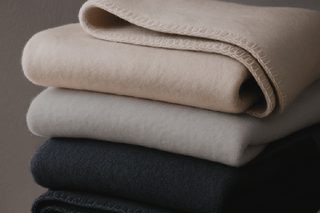
Left: 100% cashmere. Right: 90% lambswool with 10% cashmere.
A fiber table offers a starting point for comparing materials. How warm a finished piece feels also depends on its construction, coverage, and the way you wear it.
What Makes a Fiber Warm?
Textiles keep you warm mainly by slowing heat loss. Still air held within a fabric plays an important part in insulation. Thickness and loft — the fullness of a fabric — help create that layer of air around the body.
Crimp, the natural waviness of a fiber, helps a fabric hold air. The Woolmark Company explains how wool’s natural crimp traps pockets of still air. Fineness affects how fibers can be spun and how they feel, but it does not determine insulation on its own. Yarn, weave or knit, and finishing all shape the finished fabric.
Both wool and cashmere are keratin fibers, made from the same family of proteins found in human hair. Their fineness and other fiber characteristics vary, and those differences interact with the way the fabric is made.
Is Cashmere Warmer Than Wool?
It can be, but equal weight alone does not settle the comparison. Cashmere is known for its fine fibers and soft feel. Under U.S. labeling rules, cashmere must have an average fiber diameter of no more than 19 microns, with a coefficient of variation of no more than 24 percent and no more than 3 percent by weight of fibers over 30 microns. The Agricultural Marketing Resource Center gives a typical range of 16 to 19 microns.
Sheep's wool spans a much wider range. Fine Merino overlaps with cashmere at the bottom — Woolmark gives Merino a range from under 17.5 to around 22–24 microns — so fine wool and cashmere cannot always be distinguished by diameter alone.
Cashmere’s fineness makes it well suited to soft, light layers. Whether a particular cashmere fabric is warmer than a wool fabric of the same weight depends on how each is made. Research on pure cashmere knitted fabrics shows that fabric structure affects thermal resistance, even when the fiber content remains the same.
You may see claims that cashmere is three, five, or eight times warmer than wool. Without details of the fabrics and test conditions, those figures are not a reliable rule for comparing finished pieces. A useful comparison considers thickness, loft, and construction alongside fiber content.
Is Wool Warmer Than Cashmere?
A wool piece can feel warmer when its thickness, loft, or coverage better suits the setting. A substantial blanket spread across the lap may offer more useful warmth at a desk than a narrow scarf. That difference reflects the design and use of the pieces, rather than a universal advantage for wool.
The Murmurs pieces below illustrate the range. Fabric weight is listed in grams per square meter — the weight of a given area of cloth, rather than the weight of the whole piece:
| Murmurs piece | Fiber | Fabric weight | Size |
|---|---|---|---|
| Whisper Long Cashmere Scarf | 100% cashmere | 260 g/m² | 63 × 12.6 in / 160 × 32 cm |
| Ember Wool Cashmere Cape | 90% wool, 10% cashmere | 391 g/m² | 44 × 45.7 in / 112 × 116 cm |
| Drift Lambswool Cape | 90% lambswool, 10% cashmere | 557 g/m² | 51 × 57 in / 130 × 145 cm |
| Lilt Lambswool Blanket | 90% lambswool, 10% cashmere | 557 g/m² | 47 × 59 in / 120 × 150 cm |
| Hush Petit Office Blanket Wrap | 100% wool | 573 g/m² | 30 × 40 in / 76 × 101 cm |
| Hush Wool Throw Blanket | 100% wool | 577 g/m² | 47 × 59 in / 120 × 150 cm |
The Whisper Long Cashmere Scarf and the Hush Petit Office Blanket Wrap serve different purposes. The Whisper Long Cashmere Scarf offers a light layer around the neck under a coat; the Hush Petit Office Blanket Wrap provides broader coverage over the lap and knees at a desk. Their fabric weights and dimensions help explain those uses, but do not establish a tested warmth ranking.
Fabric weight is one useful detail among several. A lofted, brushed fabric may insulate well without feeling especially heavy, while a compact weave can feel substantial with less loft. Read weight alongside thickness, texture, and size when choosing a piece.
Not All Wool Is the Same
“Wool” covers a wide range of fibers, from fine Merino to much coarser varieties. The name alone tells you relatively little about the softness or warmth of a finished piece.
These are three descriptions you may encounter when comparing wool pieces; they refer to breed, first shearing, or general fiber content:
- Merino — fine, soft, and close to cashmere in diameter at the low end. Common in base layers and fine knitwear.
- Lambswool — wool from a sheep's first shearing. Often valued for its softness, though fineness and feel vary with the sheep and the finished fabric. Murmurs uses it, blended with cashmere, in the Drift Lambswool Cape and Lilt Lambswool Blanket. For a closer comparison, read Lambswool vs. Cashmere.
- Sheep’s wool — a broad description rather than a specific grade. Depending on the yarn and construction, it can make a light layer or a substantial blanket. The Hush Petit Office Blanket Wrap and the Hush Wool Throw Blanket are both made from 100% wool.
When comparing wool and cashmere, consider which wool is used and how the piece is made. Fine Merino and cashmere can both offer a soft feel against the skin. A scarf and a blanket call for a different comparison: where they will sit, how much they cover, and how you want them to feel.
Does Wool Itch More Than Cashmere?
Cashmere often feels less prickly than coarser wool, though comfort varies from person to person. Coarser fibers can press against the skin, while finer fibers bend more readily. Cashmere’s average diameter is limited by its labeling definition, but that does not guarantee that every fiber — or every finished piece — will feel comfortable to everyone. Fine Merino can also be a soft option for next-to-skin wear.
At Murmurs, where a piece touches you helps guide the fiber choice. The Whisper Long Cashmere Scarf is 100% cashmere because it sits directly against the neck. The Hush Wool Throw Blanket is 100% wool because it goes over your clothes, on a lap or a sofa, where its texture may be less noticeable than against bare skin.
Which Breathes Better?
Fiber content alone does not establish which piece will feel more breathable. Woolmark’s research factsheet reports that wool can take up moisture equivalent to as much as 35% of its own weight before feeling wet. Wool also releases heat as it absorbs moisture, which can contribute to comfort in cold, damp conditions.
Cashmere is also a keratin fiber that can absorb moisture vapor, but wool’s absorption figure should not be treated as a measured result for cashmere. In everyday use, fabric construction and layering affect how easily heat and moisture move away from the body. An open weave generally allows more airflow than a compact one, while the layers underneath also influence comfort.
Why Blend Wool and Cashmere?
A wool-and-cashmere blend can balance softness with body and resilience. The ratio is one part of that balance; yarn, construction, and finish help determine how the piece falls and feels.
Wool can bring spring and body to a cape or blanket, while cashmere can contribute a softer feel. In a 90/10 blend, wool makes up most of the cloth, with cashmere as a smaller part of the mix. The finished texture reflects how both fibers are worked together.

The Ember Wool Cashmere Cape is 90% wool and 10% cashmere at 391 g/m² — a lightweight cape, cut as one panel with a soft V-neckline. The Ember Oversized Wool Scarf is the same cloth at 86.6 × 19.6 in / 220 × 50 cm. The Drift Lambswool Cape and Lilt Lambswool Blanket use the same 90/10 lambswool-to-wool ratio as in Ember, at 557 g/m².
Where Does Baby Camel Hair Fit?
Baby camel hair offers another option for a soft, warm layer. Its feel depends on the blend and finish, rather than a fixed position between wool and cashmere. The Murmur Baby Camel Hair Cape is 50% baby camel hair and 50% wool, with a brushed surface and a dry hand. If that is the comparison you are weighing, Baby Camel Hair vs. Cashmere explores the differences in more detail.
Wool vs. Cashmere for Everyday Use
Start with where you will use the piece and how you want it to feel.
For a scarf
Cashmere is a good option when softness at the neck and a light feel matter most. The Whisper Long Cashmere Scarf is 100% cashmere at 63 × 12.6 in / 160 × 32 cm and folds into a compact layer. A wool-and-cashmere scarf makes sense when you want enough fabric to open across the shoulders: the Ember Oversized Wool Scarf is wide enough to double as a wrap on a plane.
For an office blanket
Wool is a practical starting point for a substantial lap layer. A cloth with some body can feel reassuring over the knees; generous coverage and a comfortable texture matter too. The Hush Petit Office Blanket Wrap is 100% wool at 573 g/m² and 30 × 40 in / 76 × 101 cm, sized to cover the lap and knees at a desk chair. The Best Blanket for a Cold Office compares the options.
For a cape or wrap
Wool or a wool-cashmere blend can work well when you want body as well as drape. The way a cape sits on the shoulders depends on its cut and construction. The Ember Wool Cashmere Cape offers a lighter layer; the Drift Lambswool Cape has a fuller feel and more coverage.
For travel
Look for the coverage you need in a piece you can comfortably pack. The Whisper Long Cashmere Scarf at 63 × 12.6 in / 160 × 32 cm is a compact option for the neck. At 86.6 × 19.6 in / 220 × 50 cm, the Ember Oversized Wool Scarf offers more width to open across the shoulders or drape over the lap. How to Choose a Travel Blanket works through the trade-off.
For the sofa
Wool and lambswool-cashmere blends are both worth considering. For a blanket you reach for every evening, choose a weight and texture you enjoy. The Hush Wool Throw Blanket and the Lilt Lambswool Blanket are both 47 × 59 in / 120 × 150 cm; the Lilt Lambswool Blanket offers the soft feel of a lambswool-cashmere fabric, while the Hush Wool Throw Blanket has a substantial wool texture.
How Do You Care for Wool and Cashmere?
Follow the care label on the individual piece; fiber content alone does not tell you whether it can be washed. Between cleanings, a light routine helps care for both: air the piece between uses, blot spills rather than rubbing, keep it away from high heat, and store it folded rather than on a hanger.
For the Murmurs pieces featured here, the Whisper Long Cashmere Scarf, the Hush Petit Office Blanket Wrap, and the Hush Wool Throw Blanket are dry clean only. The Ember Wool Cashmere Cape, the Ember Oversized Wool Scarf, the Drift Lambswool Cape, and the Lilt Lambswool Blanket are dry clean recommended. Heat and agitation during washing can cause shrinkage and felting. Follow the individual label rather than assuming that all wool or cashmere can be washed in the same way. Our Care Guide covers pilling, spills, and storage for every piece.
Why Is Cashmere More Expensive Than Wool?
Limited yield and the work of collecting and processing the fiber contribute to cashmere’s price. Cashmere is a goat’s fine undercoat, collected by combing or shearing. The Agricultural Marketing Resource Center puts the average yield at 4 to 6 ounces of underdown per goat per year. The coarse guard hairs then have to be separated from the down by a mechanical process called dehairing before spinning.
Price reflects fiber supply, processing, and the quality of the finished piece. For a scarf worn against the neck, cashmere’s soft feel may be worth the cost. For a larger blanket or cape, wool and wool-cashmere blends offer practical options with a range of weights and textures.
Frequently Asked Questions
Is cashmere warmer than wool?
It can be, but there is no fixed ranking based on fiber content or weight alone. Cashmere can offer substantial warmth in a light layer. A wool piece may feel warmer if its thickness, loft, or coverage better suits the way you use it.
Is wool warmer than cashmere?
A wool piece can be warmer in a particular setting. The Hush Wool Throw Blanket offers coverage over the lap or body, while the Whisper Long Cashmere Scarf is shaped for the neck. Their dimensions and construction explain their different uses; the fiber labels and fabric weights alone do not establish a warmth ranking.
Is cashmere really eight times warmer than wool?
“Eight times warmer” is not a reliable general rule. The same applies to the “three times” claim. Without details of the fabrics and test conditions, those figures tell you little about how two finished pieces will compare.
Which is warmer for a scarf: wool or cashmere?
Compare the scarves’ thickness, construction, and coverage as well as their fiber content. Cashmere is a good option for a soft, light layer at the neck. A larger wool-and-cashmere scarf, such as the Ember Oversized Wool Scarf at 86.6 × 19.6 in / 220 × 50 cm, can also open across the shoulders when you need more coverage.
Which is better for a blanket: wool or cashmere?
Wool and lambswool-and-cashmere blends are practical options for everyday use. Look for enough coverage and a weight and texture that feel comfortable over your lap or shoulders. Murmurs makes the Hush Wool Throw Blanket in 100% wool at 577 g/m² and the Lilt Lambswool Blanket in 90% lambswool and 10% cashmere at 557 g/m², both 47 × 59 in / 120 × 150 cm.
Does cashmere itch less than wool?
Often, especially compared with coarser wool. Cashmere’s fine fibers can feel soft against the skin, but an average diameter of 19 microns or less is not a guarantee of comfort for every wearer. Fine Merino can also feel soft, and yarn, finishing, and individual sensitivity all matter.
Is a wool and cashmere blend warm?
It can provide a warm, comfortable layer. A 90/10 blend can combine wool’s body with cashmere’s soft feel, while the warmth of the finished piece depends on its thickness, loft, and construction. The Ember Wool Cashmere Cape is 90% wool and 10% cashmere at 391 g/m²; the Drift Lambswool Cape and Lilt Lambswool Blanket are 90% lambswool and 10% cashmere at 557 g/m².
Warmth Belongs to the Piece, Not the Label
The fiber label is a starting point. For everyday warmth, consider the whole piece: how it is made, how much it covers, and how you will wear it. A scarf tucked inside a coat and a blanket spread across your lap meet different needs, so the most useful comparison begins with the way you plan to use them.
At Murmurs, we choose the fiber after we know what the piece has to do. Next to the neck, cashmere. Over a lap in a cold office, dense wool. Across the shoulders for a whole day, a blend with enough wool to hold its shape and enough cashmere to feel right.
Softness where you feel it. Structure where you need it. Warmth designed around the way you live.
Where to Start
- Whisper Long Cashmere Scarf — 100% cashmere. 260 g/m². 63 × 12.6 in / 160 × 32 cm. Soft cashmere for a light layer at the neck.
- Hush Petit Office Blanket Wrap — 100% wool. 573 g/m². 30 × 40 in / 76 × 101 cm. Dense wool over a lap at a desk.
- Ember Wool Cashmere Cape — 90% wool, 10% cashmere. 391 g/m². 44 × 45.7 in / 112 × 116 cm. A light wool-cashmere layer for the shoulders.
- Hush Wool Throw Blanket — 100% wool. 577 g/m². 47 × 59 in / 120 × 150 cm. Pure wool, at blanket size.
- Lilt Lambswool Blanket — 90% lambswool, 10% cashmere. 557 g/m². 47 × 59 in / 120 × 150 cm. A soft lambswool-cashmere blanket for the sofa.
- Browse 100% Wool, Cashmere, or all Blankets.
- Comparing lambswool specifically? Read Lambswool vs. Cashmere.
- Weighing camel hair instead? Read Baby Camel Hair vs. Cashmere.
- Choosing for a cold desk? Read The Best Blanket for a Cold Office.